An ordinary afternoon, seen seven ways
A friend leaves a café. You notice their hand on the door, follow them along the pavement, then turn when rain starts to fall. There is no single 'best camera' for that afternoon. A zoom isolates the hand. A gimbal keeps pace on the pavement. A waterproof camera follows into the rain. A 360 camera can discover, afterward, what happened behind you.
That is the question behind this selection: what kind of shot does each camera make easier, and what does it give up to do it? The distinctions are practical enough to survive beyond this month's model names.
A flexible frame, or a moving one?
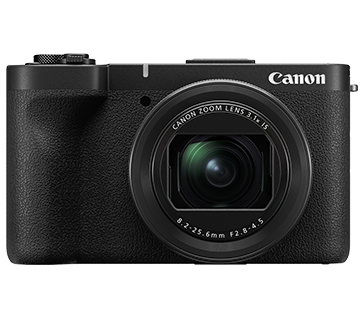
The Canon PowerShot V1 and DJI Osmo Pocket 3 are both cameras you can carry without choosing a lens first. They make different promises. The V1's 17–52mm-equivalent video zoom can move from the whole café to a detail at the table without your feet moving. Its built-in ND filter helps in bright light, and its fan addresses the heat of compact 4K recording. If you select 4K60, though, the picture crops by roughly 1.4×; the wide end stops being as wide.
The Pocket 3 keeps one fixed wide view, but its three-axis mechanical gimbal lets you walk with your friend and turn toward them smoothly. Its 1-inch sensor and 4K120 slow-motion mode are impressive for the size; the distinctive reason to own it is the moving perspective. Choose the Canon when you need to change framing from where you stand. Choose the DJI when the movement of the camera is part of the story.
What kind of camera system would you keep?
Fujifilm X-M5, Sony α6700 and Panasonic Lumix S9 all let you change lenses. That makes their body prices incomplete: a small zoom or a fast prime changes both the cost and the look. Their more revealing differences are in the way they ask you to work.
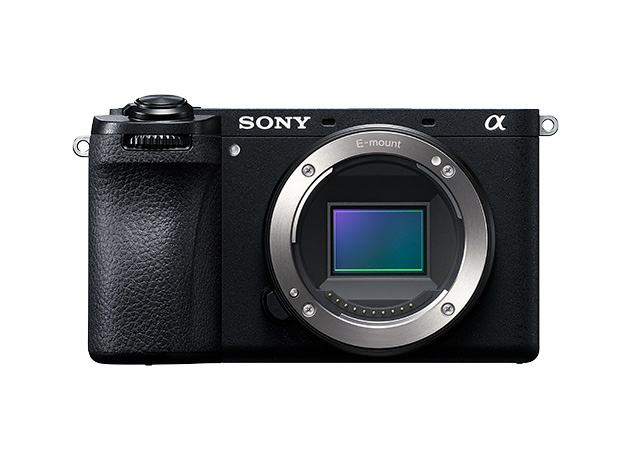
The X-M5 makes color immediate. Its Film Simulation dial draws on Fujifilm's photographic identity, and its 6.2K 3:2 open-gate video leaves height for horizontal and vertical edits. It is small and relatively approachable, though it relies on digital stabilization rather than in-body stabilization. The α6700 is the more rounded long-term hybrid: 6K-oversampled 4K60, cropped 4K120, five-axis stabilization, dedicated subject-recognition autofocus, and a broad E-mount lens system. Its higher body price makes most sense if you expect to keep making both photographs and films.
The S9 puts a full-frame sensor, five-axis stabilization, 6K open gate and Panasonic's in-camera Real Time LUT looks into a compact body. It gives more sensor area and a different color workflow, while giving up an eye-level viewfinder and a mechanical shutter; 4K60 is cropped. For a deliberate full-frame video kit it is compelling. For frequent still photography or long continuous takes, those constraints deserve attention.
When the camera enters the scene
The GoPro MISSION 1 PRO takes a conventional frame into places a larger camera might avoid. Its 1-inch sensor records up to 8K60 in a flat 16:9 image, and the camera is waterproof to 20m. You aim it at the action, then decide later whether to crop within that already chosen direction. The fixed ultra-wide lens gives action its force but limits portraits and distant subjects.
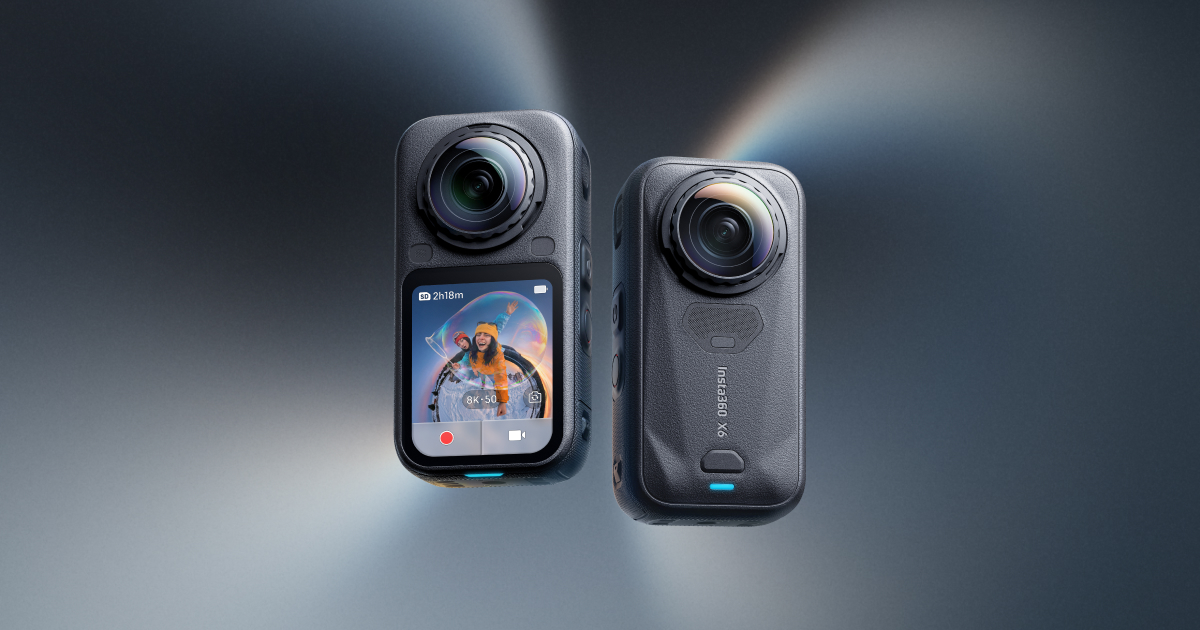
The Insta360 X6 changes the order of those decisions. Two lenses record the whole surrounding sphere at up to 8K50, so you can choose the direction of the flat shot during editing. That can save an unpredictable moment or create a reveal you could not perform live. The price of this freedom is more editing and less detail in a reframed flat view: the 8K pixels cover every direction, rather than only the rectangle you will export.
Read the spec through the shot
A sensor size is not an image-quality score. Lens choice, light, focusing, stabilization and the exact recording mode all shape the result. Nor do all 8K labels mean the same thing: GoPro's flat 8K and Insta360's spherical 8K describe different fields of view. Open gate records more of a sensor's height, which is useful for reframing into different aspect ratios; it does not automatically make a better finished picture.
Before choosing, write down the scene you expect to shoot most often. Will you stay in one place and change the frame, walk with someone, build a lens kit, enter bad weather, or decide the angle later? Then compare the full kit, including its lens where needed, its recording crop, and the way you will handle footage. Those questions reveal more than counting pixels.
Our starting points
For one adaptable camera without a lens purchase, start with the Canon V1. For a film built around following people, start with the Pocket 3. For a lens system at a smaller initial body cost and a distinctive color language, study the X-M5; for a more complete photo-and-video system, study the α6700. Choose the S9 when compact full-frame open gate and its color workflow are the attraction. Bring the GoPro into the action; bring the X6 when the action refuses to stay in one direction.
Before buying, look at full-resolution sample footage in the exact mode you intend to use, and handle the camera if you can. Make the first minute with the camera you own, too. It will tell you which limitation is real for you.
Part of The Everyday Filmmaker. Compare the cameras →