Canon / Cameras
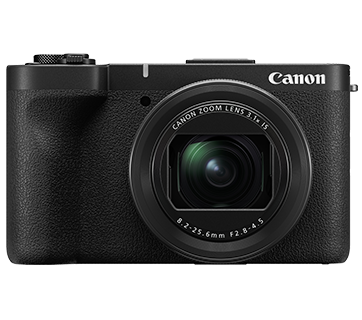
PowerShot V1
You want framing, exposure and sound controls in one compact, without choosing a separate lens.
We may earn a commission if you buy through this link.
You want framing, exposure and sound controls in one compact, without choosing a separate lens.
4K50/60 crops the view by about 1.4× and disables Movie Electronic IS, Subject Tracking IS and Auto Horizontal Compensation. Optical IS is separate.
Stay at the table. Change the frame.
A cup lands beside a hand. The V1 lets you move from the whole table to a closer framing without changing your seat. Its built-in lens, ND filter, cooling and sound connections make a considered little filming kit out of one object. The 17–52mm-equivalent video zoom runs from very wide to normal; it is not a long telephoto for details across a room.
Record, hear, finish
Begin with ordinary-color 4K24/25/30. Electronic stabilization narrows the base wide view; check your framing after selecting it.
Microphone input and headphone output let you place the microphone near the voice and listen. Check the fan setting: its sound can reach the recording.
Import a short normal-color clip into your existing editor first. Choose Canon Log 3 only when you want a separate color-conversion step.
Light, heat and a quiet conversation
The internal three-stop ND admits one-eighth as much light, helping preserve a chosen aperture or shutter time outdoors. It cannot solve every bright scene. Cooling also has conditions: the fan setting, microphone position and take length belong in the same decision. The ordinary-movie ceiling is six hours per clip, with earlier stops possible; a fan does not mean unlimited recording.
A compact built for the person in front of it
Canon’s 2019 G7 X Mark III used a 24–100mm-equivalent lens. V1’s wider video range, articulated screen and cooling suggest a different priority: operating from in front of the camera. That is our reading of the design, rather than a claim of direct succession. Firmware 1.2.0 also expands close-up demonstration autofocus beyond its original mode restrictions.
What the box still needs
Canon excludes a memory card, interface cable and charger. Check the card class for your selected bitrate and whether you already own a compatible power supply. The dated Canon offer below is separate from our B&H shopping link; retailers may have different prices and stock.
Before you choose
Sony’s smaller ZV-1 II has an 18–50mm zoom and ND, but electronic stabilization and a 4K30 ceiling. Its $899.99 observed offer is not cheaper than this V1 offer. Canon’s $799.99 R50 V / RF-S 14–30mm kit is another route if changing lenses matters; it gives up V1’s built-in ND and cooling. Canon kit stock is unresolved.
Try this
Film the cup at both ends of the zoom from one position. Then move closer to match its size. Zoom changes framing; moving changes the relationship between foreground and background.
THE LARKIVE NOTE
Stay at the table. Change the frame.
A cup lands beside a hand. The V1 lets you move from the whole table to a closer framing without changing your seat. Its built-in lens, ND filter, cooling and sound connections make a considered little filming kit out of one object. The 17–52mm-equivalent video zoom runs from very wide to normal; it is not a long telephoto for details across a room.
- Working configuration
- V1 with built-in 17–52mm-equivalent f/2.8–4.5 video zoom
- Mass and scope
- 426g
- Normal recording route
- Begin with ordinary-color 4K24/25/30. Electronic stabilization narrows the base wide view; check your framing after selecting it.
- Sound
- Microphone input and headphone output let you place the microphone near the voice and listen. Check the fan setting: its sound can reach the recording.
- Important limitation
- 4K50/60 crops the view by about 1.4× and disables Movie Electronic IS, Subject Tracking IS and Auto Horizontal Compensation. Optical IS is separate.
Comments
Leave a comment. Reported comments are hidden.
Loading comments…